
By Insolare on July 4, 2026
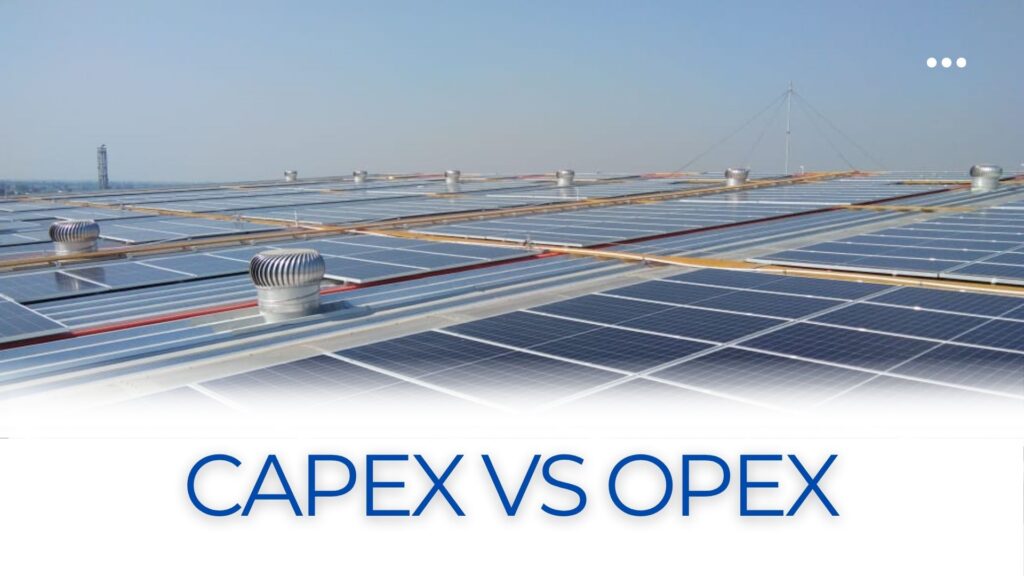
OPEX and CAPEX Difference: How to Choose the Right Solar Model for Your Business
Understanding the Opex and Capex Difference in the Solar Industry
Solar energy is no longer a distant prospect; it is a strategic business decision today. As energy costs rise in India, companies are increasingly adopting solar to reduce operating expenses and improve energy resilience. However, before installing a solar system, one key decision remains: choosing between OPEX and CAPEX.
Both models help businesses save money. Yet, they work in very different ways. The right option depends on capital, risk, and long-term plans. Therefore, this blog explains the basics in clear and simple terms. By the end, you will know which model best suits your business.
What Is OPEX and CAPEX?
To begin with, let us understand the core meaning.
OPEX stands for Operating Expenditure. CAPEX stands for Capital Expenditure. These terms define how a business pays for assets.
In solar projects, the major OPEX and CAPEX difference determines who owns the system, who pays upfront, who carries performance and maintenance responsibility, and who carries the risk.
The Fundamental Difference in OPEX and CAPEX
The fundamental difference lies in ownership and payment structure.
- In the OPEX model, the business does not own the solar plant. A third party installs, owns and operates it. The business only pays for the electricity used.
- On the other hand, in the CAPEX model, the business purchases the entire solar system. It owns the asset and uses the power it generates.
Although both reduce power bills, the financial impact is different. Hence, understanding the OPEX and CAPEX difference helps avoid costly mistakes.
How the OPEX Model Works?
The OPEX approach is also called the RESCO or PPA model.
Here, a solar developer installs the system on your rooftop or land. The developer owns the system. Meanwhile, you sign a long-term Power Purchase Agreement or PPA.
You pay a fixed rate per unit of power consumed. There is no upfront cost, and monthly electricity payments are made. Also, the developer handles operation and maintenance.
As a result, OPEX is low-risk and simple, and energy costs are predictable. This is why many first-time solar users prefer it.
However, since you do not own the system, you do not get tax benefits. Long-term savings are also limited.
How the CAPEX Model Works?
The CAPEX model follows a direct ownership approach.
The business invests upfront to purchase the solar plant. This includes modules, inverters, structures, and installation.
Once commissioned, the system belongs to the business. Power generated is used directly. After the payback period, electricity is almost free.
In addition, CAPEX can also offer tax advantages such as accelerated depreciation, depending on eligibility and financial structure.
However, the owner typically bears performance, maintenance, and operational responsibility unless these are outsourced through an AMC/O&M contract.
That is why understanding the OPEX and CAPEX difference is crucial before investing.
Financial Impact of OPEX vs CAPEX
Money flow is a deciding factor.
CAPEX requires a higher upfront investment. Yet it delivers higher returns over time. Payback is often achieved in ~4–7 years, depending on tariff, state policy, plant design, and operating conditions.
OPEX requires no capital investment. Monthly power payments are predictable. This helps manage cash flow easily.
So, businesses with spare capital often choose CAPEX. Those protecting cash usually choose OPEX.
Again, understanding the OPEX and CAPEX difference helps align solar plans with financial goals.
Risk, Control, and Maintenance
Risk plays a big role in solar decisions.
In OPEX, performance risk is largely borne by the developer, backed by service-level agreements and contractual terms. Additionally, in CAPEX, the owner has greater control and higher long-term savings but also carries most operational responsibility.
Therefore, companies with technical teams may prefer CAPEX. Others may prefer risk-free OPEX.
This is another reason why understanding the OPEX and CAPEX difference matters.
Which Businesses Prefer Which Model?
Different industries have different needs.
- Manufacturing units often prefer CAPEX for maximum long-term savings.
- IT and commercial users may prefer OPEX for cost predictability.
- Owned facilities suit CAPEX, while leased facilities often suit OPEX.
- SMEs frequently lean toward OPEX due to limited capital availability.
- Large enterprises, however, choose CAPEX for long-term control.
Clearly, understanding the OPEX and CAPEX difference helps businesses pick wisely.
CAPEX and OPEX Model: Which One Should You Choose?
There is no universal answer.
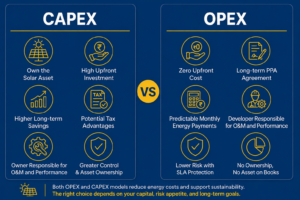
Choose CAPEX if you have the following:
- Asset ownership
- Higher long-term savings
- Potential tax advantages
Choose OPEX if you prefer the following:
- Zero upfront cost
- Lower operational risk
- Predictable monthly energy expenses
Before making a final decision, it is important to look beyond short-term savings. Start by comparing long-term costs under both models. At the same time, review your business plans and confirm whether the facility is owned or leased.
Begin by assessing how much capital your business can realistically invest and whether financing options are available. Next, evaluate your current tax liability to understand if depreciation benefits can actually be utilised. Then, consider your long-term business plans along with facility ownership, as solar projects work best with long-term site stability.
After that, analyse your risk tolerance and internal technical expertise. Some businesses are comfortable managing performance and maintenance, while others prefer transferring this responsibility. Finally, compare the total cost of ownership over a 20–25 year period to understand the true financial impact of each model.
This step-by-step approach ensures your solar investment aligns with both financial goals and operational reality.
Once again, understanding the OPEX and CAPEX difference ensures a smarter solar investment.
Final Thoughts: Make the Right Solar Choice
Solar energy is a long-term decision. So, the model you choose today impacts savings for decades.
Both options work well. Yet, their benefits differ widely.
That is why understanding the OPEX and CAPEX difference is not optional. It is essential.
When chosen correctly, solar becomes a growth driver, not just a cost saver.
Want to explore deeper comparisons, case studies, and real savings examples? Continue reading our solar insights and make informed energy decisions today.
Recent Blogs


FAQs
1. What is the difference between OPEX and CAPEX in solar projects?
The main difference between OPEX and CAPEX in solar projects is ownership and investment. Under the CAPEX model, the business purchases and owns the solar plant, making an upfront investment while benefiting from long-term savings. Under the OPEX model, a third-party developer owns and operates the system, and the business pays only for the electricity consumed through a Power Purchase Agreement (PPA).
2. Which is better for businesses: OPEX or CAPEX solar?
The choice depends on a company’s financial goals and operational priorities. CAPEX is suitable for businesses seeking long-term savings, asset ownership, and potential tax benefits. OPEX is ideal for organizations that prefer zero upfront investment, predictable electricity costs, and minimal operational responsibility.
3. What are the advantages of the OPEX model in solar energy?
The OPEX model offers several advantages, including zero upfront capital investment, predictable monthly electricity expenses, and reduced operational risk. Since the solar developer is responsible for system ownership, maintenance, and performance, businesses can adopt solar power without managing technical operations.
4. How do businesses choose between OPEX and CAPEX for a solar project?
Businesses should evaluate available capital, expected return on investment, facility ownership, tax benefits, operational responsibilities, and long-term energy goals before choosing between OPEX and CAPEX. Comparing the total cost of ownership over the system’s lifecycle helps identify the most suitable solar investment model.
5. How does InSolare help businesses choose the right OPEX or CAPEX solar model?
InSolare helps businesses evaluate OPEX and CAPEX solar models through detailed engineering analysis, financial assessment, and project-specific feasibility studies. Leveraging extensive expertise in utility-scale, commercial, and industrial renewable energy projects, InSolare recommends the most suitable investment model to optimize energy performance, reduce lifecycle costs, and maximize long-term value.
